AI TOOL / #09891
audioshake.ai
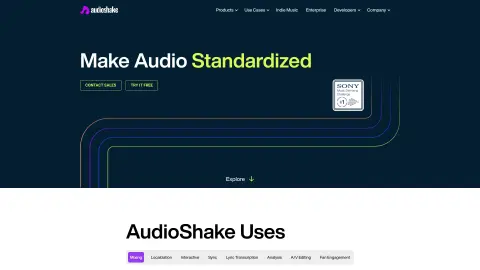
AudioShake uses artificial intelligence to split audio recordings into tracks for a variety of interactive and customizable uses.
Introduction
AudioShake uses AI to split audio recordings into stems for various interactive and customizable uses.
What is AudioShake?
AudioShake’s AI can split any recording—from music to film to user-generated content—into individual tracks, making audio more interactive, customizable, and accessible. Its services include dialogue, music, and sound effects separation; lyric transcription and alignment; and instrument stem separation. Use cases include mixing and mastering, localization and subtitling, interactive synchronization licensing, audio analysis, audiovisual editing, user engagement, and copyright compliance.
How do you use AudioShake?
Users can upload audio files to the AudioShake platform, where AI automatically separates the recording into individual tracks (vocals, drums, bass, etc.). These tracks can be downloaded and used for a variety of purposes, such as mixing, mastering, or creating interactive audio experiences.
AudioShake's core features
AI-powered audio track separation
Separation of dialogue, music, and sound effects
Lyrics Transcription and Alignment
Multi-speaker separation
Instrument track separation
Related
KUMOKIRI: The Ink Warrior
A gaming experience with a painting-style aesthetic: Fable 5.2 combined with Crayon and three.js
Farewell Light
A gameplay demonstration created throughout the entire night
"Vast Horizon": Text-based Surfing
Many people surf on the same lake; entering just one word can change the entire world.
IGNITION: Zero Edge – A fighting game
A 2D fighting game that features generated voice effects and sound clips, and allows users to save their battle records and watch replays.
Vippi-style COD shooting game
The Bay Area: A 250-Year History
Zoom in on any city or neighborhood, and select any year since 1769 to see what it looked like back then.